
Micro Grippers: David Gracias Builds Micromachines That Fold, Stick, Swim, and Sense—All Inside the Human Body.
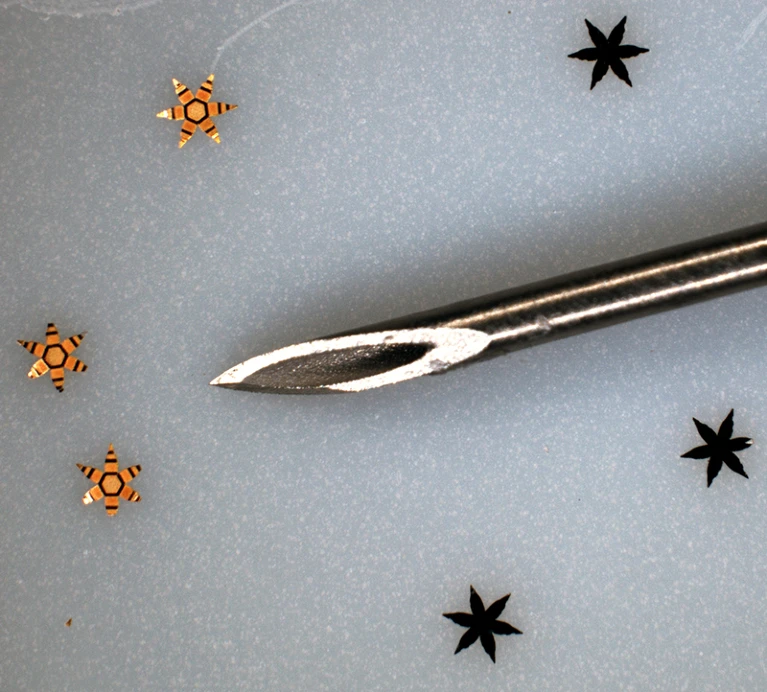
Above Image: Grippers shown next to an 18-gauge needle for comparison.Credit: Evin Gultepe, Gracias Lab, Johns Hopkins University
The tiny metal grippers could enable doctors to spot tumors far earlier than current methods allow
Researchers are pushing the boundaries of cancer detection and minimally invasive surgery with a new generation of nanorobots. David Gracias, professor of chemical and biomolecular engineering, has developed tiny hand-shaped metal grippers that can perform biopsies in hard-to-reach areas. Already tested in pigs, these devices could one day be released throughout the colon during routine screenings, enabling doctors to spot tumors far earlier than current methods allow.
His research was featured as the cover story for the Spring 2025 issue of JHU Engineering Magazine and included in a recent Nature Spotlight about “How nanobots are accelerating cancer-targeting therapies.”
Announcement by Emily Flinchum in the Department of Chemical and Biomolecular Engineering.
Latest Posts
-
 Cellular building blocks may enable new understanding of the body’s “machinery”
December 19, 2025
Cellular building blocks may enable new understanding of the body’s “machinery”
December 19, 2025
-
 Biomedical Engineer Jamie Spangler Receives President’s Frontier Award
December 15, 2025
Biomedical Engineer Jamie Spangler Receives President’s Frontier Award
December 15, 2025
-
 Johns Hopkins Postdoc Named in Forbes `30 Under 30′ List
December 8, 2025
Johns Hopkins Postdoc Named in Forbes `30 Under 30′ List
December 8, 2025