Center for 3D Multiscale Cancer Imaging
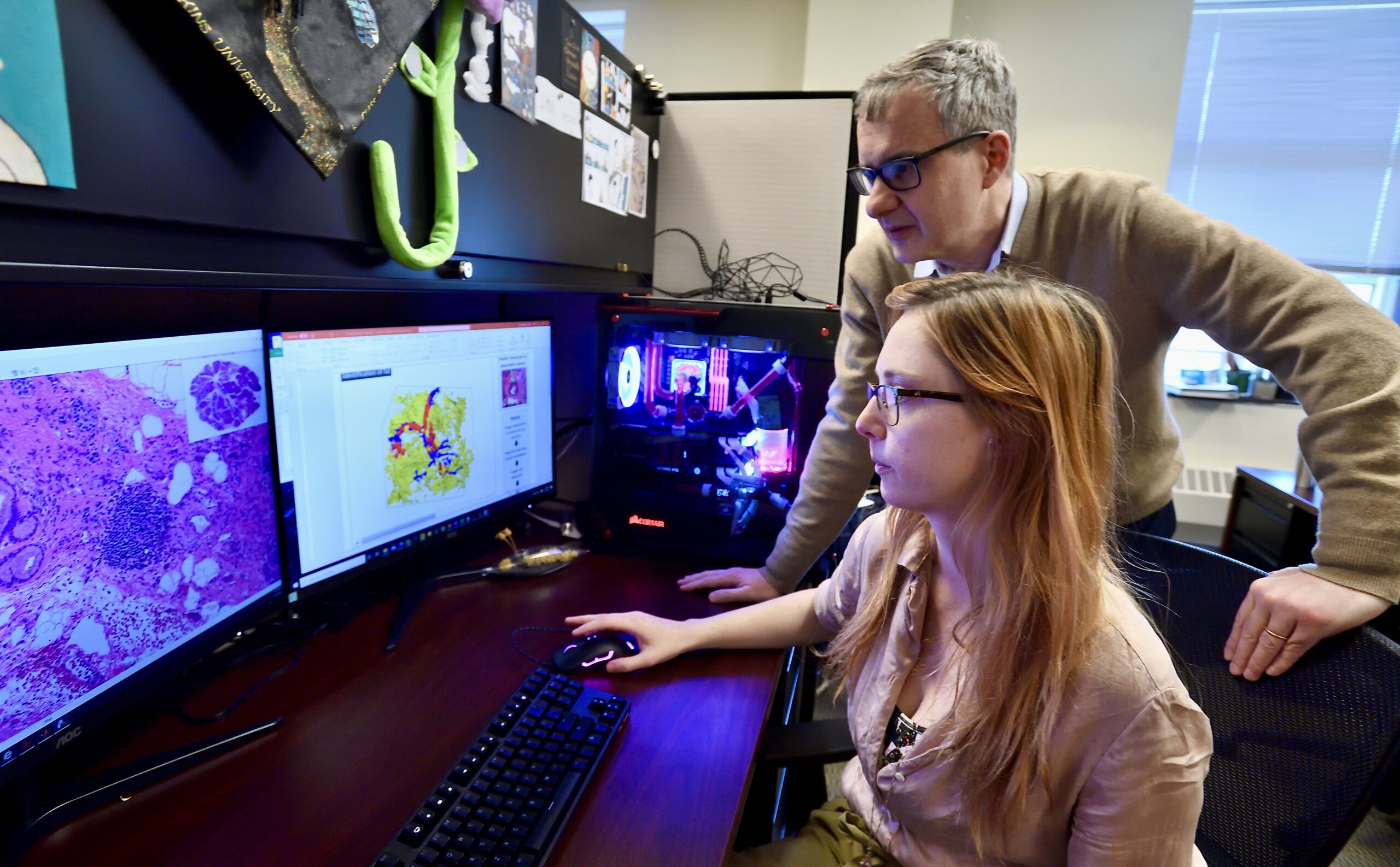
The Johns Hopkins Center for 3D Multiscale Cancer Imaging is a hub for interdisciplinary research and collaboration between oncologists, engineers, pathologists, and computer scientists. The goal is to unlock the mysteries surrounding the formation of tumors through the integration of cutting-edge molecular and cellular analysis. At the heart of the center is a research tool called CODA. It is a cutting-edge computational platform that has the ability to turn tissue slides into a 3D model—a process that creates hundreds of images of ultrathin tissue sections and aligns them with extremely high accuracy, allowing researchers and clinicians to manipulate and examine them in ways never before possible.
RNA Innovation Center
The Johns Hopkins RNA Innovation Center, in collaboration with TriLink BioTechnologies®, aims to accelerate groundbreaking research in RNA therapeutics. Their goal is to share collective expertise and technology with the scientific community to help researchers move seamlessly from concept, through discovery, and finally to human clinical studies. The center is housed at the Institute for NanoBioTechnology whose research spans molecular biology, medicine, engineering, and nanoscience, providing an ideal milieu for exploration of novel RNA therapeutics. The partnership with TriLink affords the Center access to their proprietary state-of-the-art RNA synthesis technologies, as well as their technical and cGMP manufacturing expertise. Through the synergy of these academic and commercial pillars, the RNA Innovation Center endeavors to empower investigators to work at the leading edge of discovery.
Past Research Centers
Physical Sciences-Oncology Center (2009-2019)
The Johns Hopkins Physical Sciences-Oncology Center combined physics, biomedical engineering, cancer biology, ecology, and clinical medicine, to transform our understanding of metastatic cancer, The center analyzed the molecular and physical mechanisms underlying the initial steps of metastasis, invasion and migration, and developed predictive models to identify new therapeutics. Additionally, computational biophysicists used mathematics to systematically develop a quantitative understanding of the physical cues involved in the metastasis.
The center was co-led by Denis Wirtz, core researcher at the INBT and vice provost for research at Johns Hopkins University and Ken Pienta, the Donald S. Coffey Professor of Urology and a professor of oncology at the Johns Hopkins School of Medicine, and collaborating institutions included the Washington University School of Medicine, University of Arizona, and the University of Pennsylvania Abramson Cancer Center.
Center for Cancer Nanotechnology Excellence (2010-2015)
The Johns Hopkins Center of Cancer Nanotechnology Excellence brought together scientists, engineers, and doctors to develop nanotechnology-based diagnostic platforms and therapeutic strategies for comprehensive cancer care. It was part of a multi-center effort by the National Cancer Institute’Alliance for Nanotechnology to develop and apply nanotechnology to cancer research.
The center was co-led by Peter Searson, core research at the INBT, professor of materials science and engineering, and Joseph R. and Lynn C. Reynolds Professor of Engineering, and Martin Pomper, former INBT associate researcher and former professor of radiology at the Johns Hopkins School of Medicine.
Engineering in Oncology Center (2009-2014)
The Johns Hopkins Engineering in Oncology Center explored the physical underpinnings that drive the growth and spread of cancer. The team used nontraditional approaches to cancer research by studying the physical laws and principles of cancer; evolution and evolutionary theory of cancer; information coding, decoding, transfer and translation in cancer; and ways to deconvolute cancer’s complexity. In addition to research, the center had a multidisciplinary training program for predoctoral students and postdoctoral fellows.
The center was co-led by Denis Wirtz, core researcher at the INBT and vice provost for research at Johns Hopkins University and Gregg Semenza, professor of genetic medicine, pediatrics, radiation oncology, and molecular radiation sciences, biological chemistry, medicine, and oncology at the Johns Hopkins University School of Medicine. Collaborating institutions included the University of North Carolina, University of Florida, and University of Connecticut.