Better Packaging for Better Therapy: Improvements to Nanoparticle Assembly Make More Efficient Therapeutics
Story by Turash Haque Pial and Gina Wadas
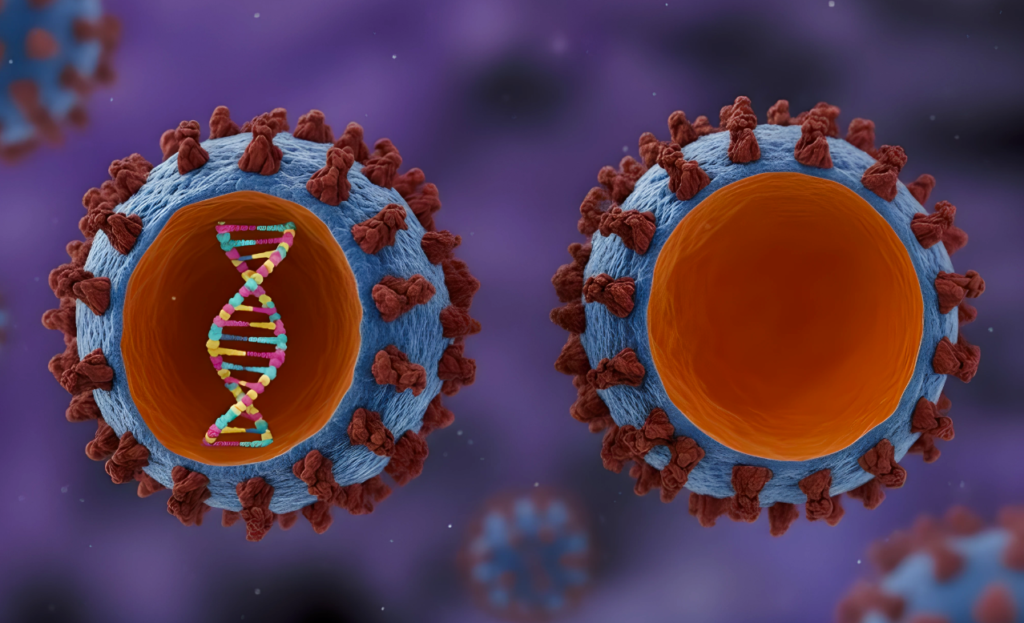
Above image (credit Turash Haque Pial): Illustration of lipid nanoparticles used for RNA delivery. The particle on the left is loaded with RNA (shown as a helix), while the particle on the right is empty. Controlling this variability in RNA encapsulation is key to improving the efficiency, consistency, and safety of RNA-based therapeutics.
Materials science and engineering researchers have announced a new approach that makes the tiny fat‑based particles used to deliver RNA medicines — called lipid nanoparticles — far more consistent in how much therapeutic material they carry.
Lipid nanoparticles (LNPs) power many RNA treatments, including the COVID‑19 mRNA vaccines, but packing the RNA therapeutic inside LNPs comes with challenges. Some particles are packed with the correct amount of RNA while others are overfilled, underfilled, or empty. That inconsistency can weaken treatments, require higher doses, and increase side effects — problems that are especially serious for patients who need repeated or long‑term therapy for diseases such as cancer, genetic disorders, or chronic illnesses.
“Our goal is to understand why this uneven distribution happens and how to control it to make drug delivery more consistent,” said Tine Curk, assistant professor of materials science and engineering and associate researcher at the Institute for NanoBioTechnology (INBT).
LNPs are like a fleet of delivery vans shipping packages. If some vans leave the warehouse empty, some with too many items crammed in, and some with just the right load, that inconsistency wastes trips, resources, and can damages goods. If we know why the vans are loaded unevenly, we can make changes that will improve loading, save resources, and make delivery more efficient.
Curk and Turash Haque Pial, postdoctoral researcher in the Department of Materials Science and Engineering, used computer simulations, machine learning, and laboratory experiments to study how LNPs form and trap RNA during manufacturing. They found that RNA packaging depends not only on the chemical ingredients but also on timing — specifically, how quickly RNA molecules move and how fast the lipids self‑assemble into particles. With that insight, the researchers developed design rules to control the assembly process. By adjusting mixing speeds and salt concentrations, the team dramatically reduced the number of empty or poorly loaded particles and produced LNPs with a much more even RNA distribution. The changes also achieved stronger gene‑silencing effects at lower doses than standard formulations and required less non‑RNA material (like extra lipids), which could lower the risk of side effects.
Their results were published in Advanced Functional Materials.
The research was conducted in collaboration with Hai-Quan Mao, professor of materials science and engineering, and director of the INBT, and Tza-Huei Jeff Wang, professor of mechanical engineering and core researcher at the INBT, highlighting a multidisciplinary effort spanning computational modeling, experimental validation, and translational bioengineering. The team’s next steps include adapting the approach for more complex RNA therapies and tailoring formulations to target specific diseases or tissues. The team is also developing user‑friendly tools so other scientists and developers can apply the design rules when engineering RNA‑LNP medicines.
“By making RNA delivery more predictable and efficient, this advance could reduce required doses and side effects, bringing RNA therapies closer to safe, repeatable treatments for chronic illnesses and precision medicine,” said Pial
This work was supported by start-up funds provided by the Whiting School of Engineering at JHU to Tine Curk, a grant from the National Cancer Institute to Hai-Quan Mao (R01CA293906-01A1), and the National Institute of Allergy and Infectious Diseases (R01AI183336, R01AI181217) to Tza-Huei Wang . Computational work was carried out at the Advanced Research Computing at Hopkins (ARCH) core facility (rockfish.jhu.edu), which is supported by the National Science Foundation (NSF) grant number OAC 1920103.