Studying Cells to Better Understand Aging
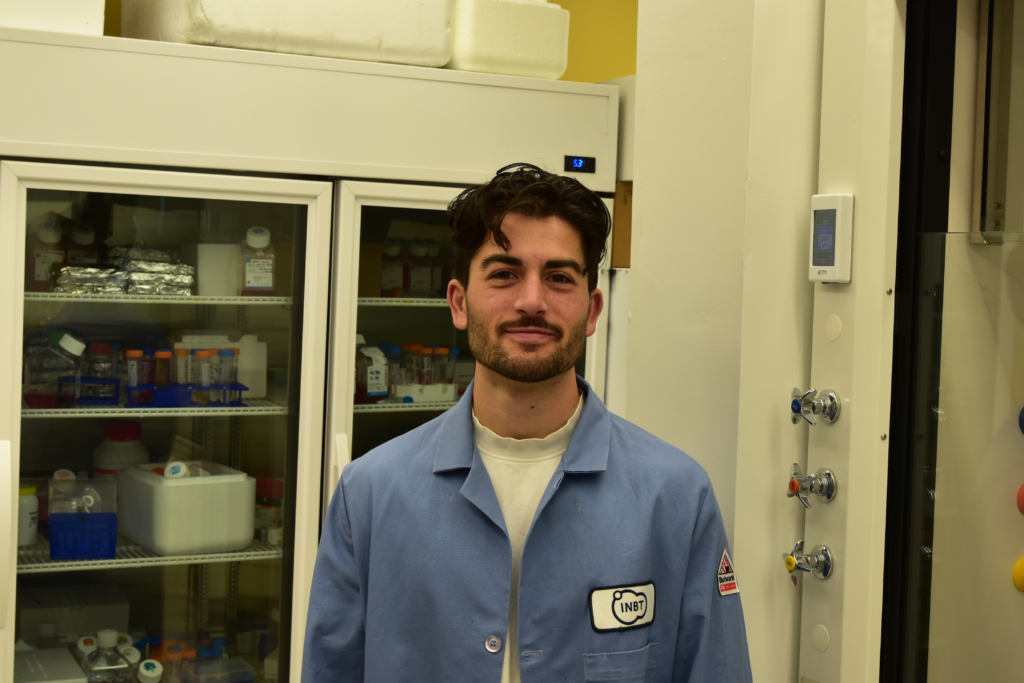
Nico Macaluso, a fourth-year chemical and biomolecular engineering PhD candidate, always viewed our perception of aging and what it means to be healthy as extremely narrow. Wanting to contribute positively to science and human health, Macaluso pursued science as a means to this goal of improving the way humans age.
Macaluso first completed his bachelor’s and master’s degree in chemical engineering from the University of Florida. As an undergraduate he studied chemical engineering, specifically, chalcogenide perovskite for photovoltaics before transitioning to researching CRISPR systems for disease detection and gene editing during his master’s studies. This research eventually led to pursuing his PhD with Jude Phillip, core member in the Institute for NanoBioTechnology and assistant professor of biomedical engineering in the Department of Biomedical Engineering
Together, Macaluso and Phillip study how cells change as we age, and want to develop an actionable and novel platform to try and bridge disease detection and personalized precision therapy, which extend the enjoyable and healthy parts of all people’s lives.
What are you researching?
I am researching how changes in the physical behavior of cells as a person ages can serve as indicators of their underlying health, treating cells as a sensor. First, I try to identify these changes and if they could lead to unhealthy outcomes, then I work on reprogramming the cells to promote healthier and more young-like behavior. Specifically, I am investigating immune cell response, cancer killing ability, and wound healing in T cells and senescent cells. I used the size and shape of fibroblast cells to profile senescence across donors from their 20’s to their 80’s, and this led to the discovery of subsets of senescence cells with different functions. I used the movement and size of T cells to predict and identify CD4+ T cell subtypes and collaborated within the lab to find ways in which we can manipulate the microenvironment of T cells to change their behavior and their ability to sense. Hopefully these projects will come together to uncover the basic biology needed to create a targeted therapy that reprograms immune cells to clear pathogenic senescence subtypes.
What are the challenges to studying aging cells?
Biological systems are incredibly complex, and a lot is unknown about them. Since every person is different and has a unique cellular profile, it makes sense to use their cells to learn about their health. But with that comes challenges in developing case-by-case solutions. There is also a challenge of bringing together immunology and engineering principles into one single project. There is also the notion that some aspects of aging are natural and healthy, so deciphering between an increased understanding and an overzealous attempt to correct something is important.
What are you doing to overcome these challenges?
Overcoming these challenges requires addressing them from several directions.
We need to uncover more information about basic biology, and frame it as an addition to our current understanding to supplement rather than derail an entire field. Also, we need more people to collaborate in multidisciplinary teams and hopefully pioneer this idea of geroengineering. Bringing together the molecular scale changes of multiomics with the mesoscale of biophysical and environmental changes I believe gives us a unique edge.
You presented your research at the Hopkins on the Hill event to government officials. What did that experience teach you?
Sharing my research with Dr. Phillip at Hopkins on the Hill was an eye-opening opportunity to the type of discourse and science communication necessary for a broad audience. The impact of not only my work but my peers at Hopkins was inspiring and motivating, and the genuine interest in pushing the boundaries of knowledge across STEM was felt by the press and members of government. It felt rewarding to see our endeavors recognized as a contributor to such an impressive display of hard work coming out of Hopkins.
What are the impacts of your research if successful?
Overall, this research can improve the standards of care and quality of life for people. The initial goal is to reframe the way we think about precision medicine at the single cell level. Eventually, I hope to play a role in establishing new drug discovery pipelines to treat age-related and other diseases, allowing everyone the opportunity to live a healthier life for longer.
When you are not doing research, what do you do in your spare time? Or what interests do you have that you would like to do if you had more time?
I lead several clubs at Hopkins, including HopStone Capital, the Graduate Student Liaison Committee, and Johns Hopkins Graduate Consulting Club. I play for the Johns Hopkins Men’s Club Soccer Team and play intramurals for sports such as volleyball, flag football, and soccer. Outside of Hopkins, I also play soccer in the Charm City Soccer League. I enjoy exercising by going to the at the gym or running. I enjoy surfing whenever I go home to Florida, and most of all, I enjoy spending time with friends.