Pathways to Entrepreneurship

Faculty turn their discoveries into impactful commercial ventures.
Benefiting society is a prime motivator for many scientists and engineers. A direct way to pursue this aim is via entrepreneurship, where discoveries in the lab can translate to the commercial sector. Yet for many faculty members, finding the time to launch a business, given their myriad other responsibilities, is inherently daunting.
To help navigate the challenges of entrepreneurship at Johns Hopkins, the university established a tech incubator, Johns Hopkins Technology Ventures (JHTV), over a decade ago. JHTV guides researchers on whichever path makes the most sense for their particular innovation. The paths available include creating a startup company (often the most readily thought of), as well as obtaining a patent or seeking corporate collaboration and licensing opportunities. “We work with a lot of faculty to get their ideas out of academia and out into the world,” says Elizabeth Burger, the senior director of strategic initiatives at JHTV. “Through one or more of the entrepreneurial pathways, we’re here to support faculty on their journey, especially junior faculty who are new to this kind of enterprise.”
One young faculty member who is working with JHTV to realize the profound potential of his research is Jude Phillip, Engr ’15 (PhD), an assistant professor of biomedical engineering who joined Johns Hopkins in 2023. His lab focuses on developing technologies that can predict and modify aging trajectories, overall helping people live healthily into their 70s, 80s, and beyond. “We’re applying engineering to aging research,” says Phillip. “We want our work to have an impact on people, whether it be through clinicians or hospital systems or right-to-end users.”
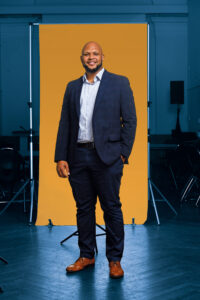
“Through one or more of the entrepreneurial pathways, we’re here to support faculty on their journey, especially junior faculty who are new to this kind of enterprise.” —Elizabeth Burger
Boosting older adults’ welfare is a largely unmet and increasingly dire issue; by the mid-2040s, it’s estimated that more people will be over 60 than under 18 years of age across much of the developed world, including the United States. Given this urgency, Phillip and colleagues are presently exploring all three entrepreneurial pathways. Over the last few years, the researchers have submitted several reports of invention to Johns Hopkins. These discoveries are presently being evaluated for potential patenting or commercial application by JHTV, which meets with Phillip regularly to offer development feedback and strategy.
Meanwhile, companies in the pharmaceutical and venture capital spaces have also begun reaching out to Phillip about possible partnerships, investment, and licensing. In light of such buzz, Phillip and his team are additionally considering creating their own startup, again leveraging JHTV’s expertise. “We have a lot of ways we can go at this time, and JHTV has been super-instrumental in getting us to this stage,” says Phillip, who serves on the JHTV faculty advisory committee.
One key discovery from Phillip and colleagues is that senescent cells—aged cells that no longer divide and proliferate—are not all the same, as had been thought. Studies have tied the buildup of senescent cells to age-related disease, due to these cells releasing pro-inflammatory molecules that degrade tissue function. Phillip revealed, however, with machine learning and imaging techniques that at least three subtypes of senescent cells exist, only one of which strongly correlates with unhealthy aging.
“We have a lot of ways we can go at this time, and JHTV has been super instrumental in getting us to this stage.” —Jude Phillip
Those findings, in turn, have spurred development of screening platforms for gauging how different senescent cell subtypes respond to so-called senolytics—an emerging new drug class that targets senescent cells and could, in theory, lessen the brunt of some age-related maladies. “The goal here is not to kill all senescent cells, because some have beneficial roles,” says Phillip. “We just want to kill the bad ones.” Phillip and his colleagues continue to mature their techniques while assessing the most advantageous entrepreneurial approach. In this vein, JHTV has also connected Phillip with alumni entrepreneurs who’ve successfully pushed out companies, as well as hosted lunch-and-learn workshops where businesspeople have shared their startup, patent-filing, and licensing experiences.
“We’re really excited about what our work could do for the critical challenge of aging populations,” says Phillip.
Read the full story by Adam Hadhazy and published in the Johns Hopkins Engineering Magazine Fall 2025 edition.
Latest Posts
-
 Studying Cells to Better Understand Aging
May 29, 2026
Studying Cells to Better Understand Aging
May 29, 2026
-
 Reza Kalhor Receives $250,000 President’s Innovation Award
May 1, 2026
Reza Kalhor Receives $250,000 President’s Innovation Award
May 1, 2026
-
 Alum Receives Schmidt Science Fellowship
April 17, 2026
Alum Receives Schmidt Science Fellowship
April 17, 2026