Five from Johns Hopkins named Siebel Scholars
Annual award recognizes world’s top graduate students from leading institutions of bioengineering, computer science, energy science, and business
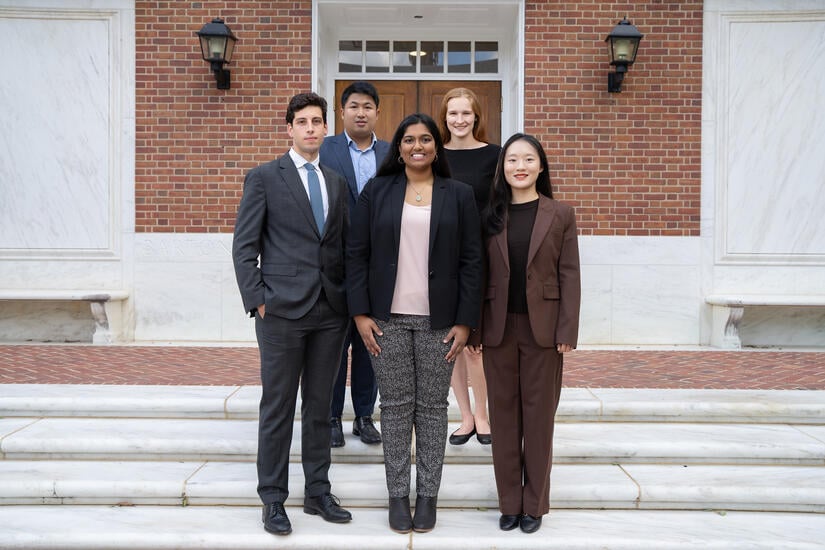
Five Johns Hopkins doctoral students have been named 2026 Siebel Scholars, an honor that recognizes students in bioengineering fields for outstanding achievement in academia, research, and leadership.
Since its founding in 2000, the Siebel Scholarship has been awarded to 85 Johns Hopkins graduate students. This year, 78 scholars were selected from leading graduate schools to join an international network of nearly 2,000 researchers, scholars, and entrepreneurs. Recipients receive $35,000 to fund their final year of studies. Additionally, they’re given the opportunity to attend annual conferences to discuss global issues alongside heads of state, scientists, and other experts seeking solutions to the world’s most complex and pressing problems.
The 2026 Johns Hopkins Siebel Scholars affiliated with the Institute for NanoBioTechnology include:
Yining Zhu
Yining Zhu is a fourth-year PhD candidate in the Department of Biomedical Engineering. He was nominated for the Siebel Scholarship by his PhD adviser, Hai-Quan Mao, a professor in the Department of Materials Science and Engineering in the Whiting School of Engineering and director of the Johns Hopkins Institute for NanoBioTechnology. Zhu engineers lipid nanoparticle platforms for gene therapy and mRNA vaccines, crafting formulations that reprogram immunity and enable precision genome editing. His portfolio spans 28 publications—eight first-author papers in Nature Biomedical Engineering, Nature Chemical Engineering, and Nature Communications—plus seven conference abstracts. Zhu has nine issued patents, several licensed by EMC2 Bio and evaluated by Bluebird Bio, Sartorius-Polyplus, and Evonik, highlighting his translational impact, while nationwide collaborations with clinicians accelerate clinical adoption. Honors such as a Young Investigator Award and two Society for Biomaterials STAR Awards recognize his scientific leadership. Drawing on skills honed as president of his undergraduate student union, he now strengthens the Johns Hopkins community as a lab captain, mentors NSF-REU trainees and junior graduate students, teaches the intersession course “Introduction to Nanomedicine,” and volunteers as a Peer Health Navigator to support student mental health.
André Forjaz
André Forjaz is a PhD candidate in the Department of Biomolecular Engineering, advised by Denis Wirtz, vice provost for research. In his research, Forjaz develops digital integrated artificial intelligence tools to study complex anatomical and molecular tissue changes in 3D. His research led to the discovery that ovarian precancers are significantly more common than previously believed: Most women will develop these lesions. He is a coauthor on 17 papers, including four as first author, and has presented at 13 conferences. As part of his research, Forjaz has mentored 11 undergraduate and graduate students. Outside research, Forjaz co-founded HOPTEC, an exchange program between Johns Hopkins and Instituto Superior Técnico in Lisbon, Portugal. He is responsible for interviewing applicants, inviting faculty seminar speakers, and planning an annual research symposium. Forjaz is the D.C.-Maryland-Virginia chapter leader of the Portuguese American Post-Graduate Society, where he organizes events to foster cultural exchange and scientific collaboration.
Jessica Stelzel
Jessica Stelzel is a PhD candidate in the Department of Biomedical Engineering in the Doloff and Mao labs, working to unravel the mechanisms behind biomaterials-induced tissue remodeling. Stelzel’s highly collaborative research has resulted in authorship on seven publications, including four in Nature portfolio journals, and 14 presentations. She has received several prestigious awards, including the F31 Fellowship, NSF GRFP, and ARCS Scholarship. Stelzel is a Johns Hopkins Technology Ventures Commercialization Academy fellow and has interned at the SLAC National Accelerator Laboratory, a bioprinting startup, and the Navy’s metallurgy branch. Stelzel is committed to mentorship, teaching, and advocacy. She has trained numerous PhD students, technicians, and undergraduates. As the manager of her center’s flow cytometer, she has provided extensive flow training to over 50 students. She developed and taught an undergraduate immunology course and volunteers by teaching science lessons in Baltimore public schools. She has also held multiple student government leadership positions including committee chair, class representative, and secretary.
Read about all the candidates in the Johns Hopkins Hub.