Johns Hopkins Integrated Imaging Center focuses on data

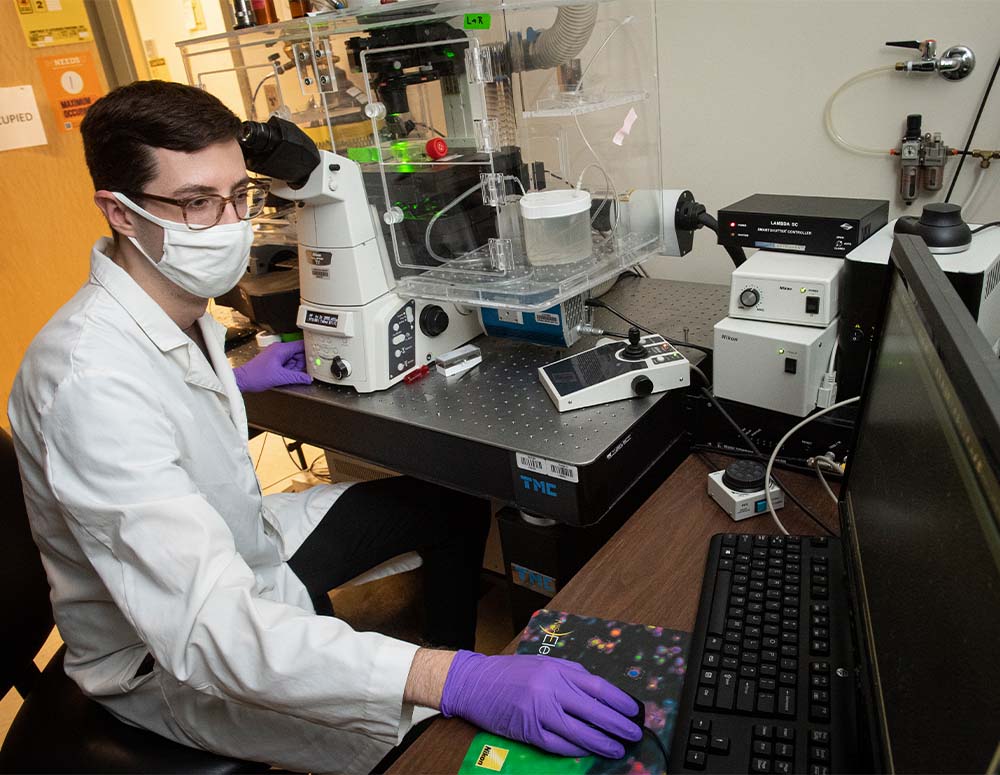
Shyenne Yang positions Drosophila embryos for fluorescence imaging. Photo by Marty Katz/baltimorephotographer.com

Heavy, black curtains and dimmed lights shroud the core of the Johns Hopkins Integrated Imaging Center (IIC). Yet researchers who peer through the advanced microscopes cloaked by these dark draperies view experimental samples more clearly than ever thanks to a combination of the high-tech equipment and the creative expertise offered by the center’s seven-member staff.

When describing Johns Hopkins University’s showpiece microscopy facility, it’s easy to rattle off a laundry list of available equipment and laboratory space able to prepare samples with nearly any contrasting agent found in the literature. The Homewood-based center contains devices that can image a sample in virtually any manner in 2-D, 3-D and even 4-D. IIC’s 3,500 square-foot facility comprising space in Dunning, Jenkins, and Olin Halls, boasts more than $7.5 million worth of state- of-the-art imaging equipment, including a Zeiss laser scanning microscope (LSM) 510 VIS confocal with a Confocor 3 fluorescence correlation spectroscopy (FCS) module—one of only a very few such uniquely configured laser scanning microscopes in the United States.

Director J. Michael McCaffery, a research professor in the Department of Biology at the Krieger School of Arts and Sciences, said the Hopkins community is thrilled to have access to such a versatile microscope with fluorescence correlation spectroscopy that is capable of cross-correlation analysis, with confocal imaging and a fully enclosed environmental system for live imaging. Researchers affiliated with Johns Hopkins Institute for NanoBioTechnology (INBT), the Johns Hopkins Physical Sciences Oncology Center and Center of Cancer Nanotechnology Excellence are also glad to have access to IIC’s menu of facilities.

“Fluorescence correlation spectroscopy allows for high-resolution spatial and temporal analysis of single biomolecules with respect to diffusion, binding, as well as enzymatic reactions in vitro and in vivo,” McCaffery said. In other words, you can see and measure a lot of really tiny stuff with it, something INBT affiliated researchers working at micron/nanometer resolutions are finding incredibly useful.

The center features multiple suites devoted to specific microscopy/imaging functions, as well as facilities for all manner of sample preparation. All these advanced tools help scientists and engineers characterize nanomaterials; and image cells, sub-cellular organelles, and biomolecules/ proteins at very small dimensions. But none of this fancy equipment would be of much use to researchers without the expertise of McCaffery and the IIC staff. McCaffery brings years of experience and a background in cell biology and microbiology. The center’s associate director, William Wilson, an associate research professor in the Department of Materials Science and Engineering at the Whiting School of Engineering, describes himself as a “chemist, turned physicist, who became an electrical engineer, who is now a materials scientist.”

Staff scientist Kenneth J.T. Livi, director of the IIC’s High-Resolution Analytical Electron Microbeam Facility located in Olin Hall, offers his unique perspective on earth and planetary sciences. Researchers can also consult with microscopy specialist/ trained biologist and FACS supervisor Erin Pryce, the FACS manager Yorke Zhang, computer/IT specialist Marcus Sanchez, and research assistants Leah Kim and Adrian Cotarelo, who both are currently earning their bachelor degrees in biology at Johns Hopkins.

From left, IIC director Michael McCaffery, FACS supervisor Erin Pryce, and associate director William Wilson with the BD FACSVantage SE. Photo by Mary Spiro

“Sometimes young researchers haven’t contemplated all the possibilities of how to use and apply an instrument; and don’t realize there are many different ways to utilize familiar tools in order to obtain new, in some cases better, information,” McCaffery said. “Our desire is always to approach a problem from many disparate perspectives to generate convergent data that corroborates each particular assay. Hopefully, results from each individual assay, allows the scientist to arrive at a convergent perspective that yields confidence in the results and conclusions.”

One of the easiest ways to obtain different microscopy data and improve corroboration among assays is simply to change the contrast mechanism.

“The most common contrast mechanisms used to image something are optical contrast (transparent versus opaque), polarization, and fluorescence,” said Wilson. “But there are many different ways you can manipulate how light interacts with the specimen and what you detect out of an objective.”

For example, ultrafast laser sources have made nonlinear optical forms of contrast an exciting new tool. Techniques like two-photon excited fluorescence and second harmonic generation (both available in the IIC) produce excellent spectral and structural information about samples because a smaller effective photon volume is excited. Wilson explained it like this: “Imagine turning your stereo all the way up and hearing the sound distorted. That distortion is created by the higher order acoustic harmonics from your stereo. The same happens with intense laser light resulting in new “colors” being generated from the object irradiated. The cool thing is that the different non-linear processes are often sensitive to different physical proper- ties or structural features, offering complementary information about your sample.”

In some cases, getting more detailed information simply requires looking at the right color range. The two-photon fluorescence and second harmonic signals appear at different wavelengths. If you excite a sample with enough energy to generate third order harmonics, that signal is detected at an even bluer wavelength, Wilson said. “With third harmonic generation, you only get signals from the interface of structures with no interference from anything else. This means you can simultaneously image fluorescence, polar order, and interface dynamics just by popping in a few filters and beam splitters,” he said.

“Over the past ten or so years, physicists and engineers focused on advanced microscopy, have produced better and more advanced laser and optical technologies, generating techniques that many researchers in the biological and biomedical sciences might not know exist,” Wilson said. “There also are a lot of applied physicists who are developing and using these new technologies who don’t know what an interesting sample is. We hope to help bridge this gap, becoming a place where these collaborative synergies can flourish.”

Sample preparation is another area where the center can help researchers. “Cell fractionation, for example, which is the breaking down of whole cells and separating them into their individual components, when combined with biochemical techniques and microscopy, can often allow researchers to pose more precise questions and to better analyze a biological problem,” McCaffery said.

“It is common for someone to come in and want to use a particular instrument or technique they read about in a paper,” McCaffery said. When that happens, McCaffery and Wilson are likely to give researchers “homework.”

“It’s important to remember that the goal is not to make a pretty picture,” Wilson said. “The goal is to answer a question, so sometimes we have to ask them, ‘What is your research question?’” An enviable set of microscopy tools combined with a team that brings years of training and experience from a variety of disciplines sets Johns Hopkins Integrated Imaging Center apart from the microscope on the individual researcher’s lab bench, as well as from facilities nationwide. Wherever possible, McCaffery said, IIC staff tries to be engaged in all of the research that is carried out in the center. “Simply, our involvement leads to better results and better science,” McCaffery added.

Researchers confirm this successful combination.

“The facilities at the IIC have allowed us to obtain critical information about the internal structure of our peptide nanomaterials that would have remained unknown without careful electron and fluorescence microscopy,” said J.D. Tovar, assistant professor of Chemistry. “Equally important, the scientific IIC staff members were vital participants making sure collaborative experiments were done meaningfully and students were trained competently. Our collaboration with Dr. Wilson has given some nice insights and at the same time has posed many more questions for future research.”

Praise like that for the IIC is always nice to hear, staff members say, but they emphasize that the services and tools they provide are just part of the job. “Part of being a scientist is learning not only how to gather information from a wide variety of tools but also understanding how to pose clear questions that lead to the right tools, in a nutshell, how to not waste time. If we can help you do that, then we have achieved our goal,” Wilson said.
This story originally appeared in Johns Hopkins Nano-Bio Magazine.

To read more about IIC’s facilities and services, go here.

Story by Mary Spiro

Photos by Mary Spiro and Marty Katz


Johns Hopkins Cancer Nanotechnology Training Center (CNTC) launched

(Photo: Mary Spiro/INBT)

The war on cancer is fought on many fronts, even tiny, nanoscale ones. To train new scientists and engineers to combat the spread of cancer, Johns Hopkins Institute for NanoBioTechnology (INBT) has established a pre-doctoral (PhD) training program in Nanotechnology for Cancer Medicine. Together with the institute’s previously established Nanotechnology for Cancer Medicine postdoctoral fellowship, these two training programs will comprise the Johns Hopkins Cancer Nanotechnology Training Center (CNTC).

Similar to the postdoctoral program, the PhD training in nanotechnology for cancer medicine will educate graduate students to use nanotechnology solutions to diagnose, treat, manage, and hopefully one day, even cure cancer, said the CNTC’s director Denis Wirtz, the Theophilus H. Smoot professor of Chemical and Biomolecular Engineering in the Whiting School of Engineering.

The CNTC was funded by a $1.8 million grant over five years from the National Cancer Institute. Launched in the fall of 2010, the pre-doctoral training program has already attracted highly qualified students with bachelor’s degrees in diverse backgrounds such as biochemistry, genetics, molecular and cellular biology, as well as those who majored in engineering or physics. By attracting students with these sorts of educational backgrounds, Wirtz said, INBT will help develop what he calls “hybrid scientists, engineers, and clinicians.”

“We are seeking to train people who can develop new nanoscale materials and nanoparticles that will address biological functions related to the growth and spread of cancer, or metastasis, at a mechanistic level,” said Wirtz, who also directs INBT’s Engineering in Oncology Center and is INBT’s associate director.

Anirban Maitra, professor of pathology and oncology at the Johns Hopkins School of Medicine and co-director of the CNTC, said research will focus on the identification and preclinical validation of the most cancer-specific nanotechnology based therapies, particularly using the wealth of knowledge on the cancer genome emerging from CNTC participant scientists such as Kenneth Kinzler and Bert Vogelstein, both School of Medicine faculty.

“The CNTC is uniquely poised to leverage this information for developing molecularly targeted nanotechnology-based tools for cancer therapy,” Maitra added.

Much like INBT’s other training programs, students seeking a doctorate specialization in nanotechnology for cancer medicine must jump through a few additional hoops than those students enrolled in traditional department-based pre-doctoral programs.

For example, in addition to the PhD requirements set forth by students’ home departments, CNTC fellows also complete two core nanotechnology courses, two intensive laboratory “boot camps”, one laboratory course designed to develop their skills in experimental and theoretical fundamentals in surface and materials science for biology and medicine, and one course in advanced cancer biology. Students must also complete two complementary laboratory rotations within their first year, participate in a professional development seminars, attend clinical conferences on cancer, among many other requirements. These extra steps set INBT trainees apart by giving them a more advanced skill set and making graduates more desirable in the job market, Wirtz said.

Generally, fellows take five to six years to complete the cancer nanotechnology for medicine PhD program. INBT will support CNTC trainees for two years, after which, the students will be funded by their primary departments from which their degrees will be conferred.

As many as six outstanding pre-doctoral fellows may enter the CNTC program per year. Candidates from under-represented groups in the science and engineering disciplines, including women and minorities, are encouraged to apply.

For more information about how to apply for the CNTC programs, please contact INBT’s Academic Program Administrator, Ashanti Edwards, at Ashanti@jhu.edu.

Johns Hopkins Physical Sciences-Oncology Center

Center of Cancer Nanotechnology Excellence

Story by Mary Spiro


Cancer nanotechnology mini-symposium brings students together

Jeaho Park, predoctoral student affiliated with the CCNE,  presenting at the INBT mini-symposium on cancer nanotechnology. (Photo: Mary Spiro)

About 30 people attended a mini-symposium on cancer nanotechnology hosted by Johns Hopkins Institute for NanoBioTechnology March 23. The event showcased current research from nine students affiliated with its Physical Sciences-Oncology Center (PS-OC) and Center of Cancer Nanotechnology Excellence (CCNE). Talks began at 9 a.m. in Hackerman Hall Auditorium.

“We become so focused on our own research that we don’t know what other students are working on,” said Stephanie Fraley, a predoctoral candidate chemical and biomolecular engineering in the laboratory of Denis Wirtz. “The beauty of an event like this is that we get to see work from across the campuses and across disciplines, all in one morning.”

Researchers, who each spoke for 15 minutes and fielded questions from the audience,  included the following:

  • 9:00 – 9:15 - Jeaho Park (Peter Searson Lab, CCNE): Quantum dots for targeting cancer biomarkers
  • 9:15 – 9:30 - Stephanie Fraley (Denis Wirtz Lab, PSOC): Role of Dimensionality in Focal Adhesion Protein Localization and Function
  • 9:15 – 9:30 - Kelvin Liu, PhD, (Jeff Wang Lab, CCNE): Decoding Circulating Nucleic Acids in Serum Using Microfluidic Single Molecule Spectroscopy
  • 9:45 – 10:00 - Laura Dickinson (Sharon Gerecht Lab, PSOC): Functional surfaces to investigate cancer cell interactions with hyaluronic acid
  • 10:00 – 10:15 - Craig Schneider (Justin Hanes Lab, CCNE): Mucus-penetrating particles for the treatment of lung cancer
  • Break
  • 11:00 – 11:15 - Eric Balzer, PhD, (K. Konstantopoulos Lab, PSOC): Migrating tumor cells dynamically adapt to changes in environmental geometry
  • 11:15 – 11:30 - Venugopal Chenna (Anirban Maitra Lab, CCNE): Systemic Delivery of Polymeric Nanoparticle Encapsulated Small Molecule Inhibitors of Hedgehog Signaling Pathway for the Cancer therapy
  • 11:30 – 11:45 - Sam Walcott, PhD, (Sean Sun Lab, PSOC): Surface stiffness influences focal adhesion nucleation and decay initiation, but not growth or decay
  • 11:45 – 12:00 - Yi Zhang (Jeff Wang Lab, CCNE): A quantum dot enabled ultrahigh resolution analysis of gene copy number variation

Download the CCNE-PSOC mini symposium agenda here.

John Fini, director of intellectual property for the Homewood campus schools, also gave a presentation on intellectual property and work of Johns Hopkins Technology Transfer.  Plans are in the works for the cancer nanotechnology min-symposiums to occur each spring and fall.

Johns Hopkins Physical Sciences-Oncology Center (PS-OC), also known as the Engineering in Oncology Center, is funded by a grant from the National Cancer Institute and aims to unravel the physical underpinnings involved in the growth and spread of cancer. Johns Hopkins Center of Cancer Nanotechnology Excellence, also funded by a grant from the NCI, aims to use a multidisciplinary approach to develop nanotechnology-based tools and strategies for comprehensive cancer diagnosis and therapy and to translate those tools to the marketplace.

Cancer Nanotechnology theme of INBT’s symposium, May 12-13

The Denis Wirtz lab research centers on investigations of cell micromechanics, cell architecture, nuclear shape and gene expression. Shown are healthy mouse cells with flurorescent staining of the nucleus (blue) and microtubules (green) emanating from the microtubule organizing center (red). (Photo: Wirtz Lab/JHU)

Nanoscale tools developed by engineers have yet to be fully explored and exploited for the diagnosis and treatment of diseases such as cancer. Nanotechnology for Cancer Medicine forms the focus of the fifth annual symposium for Johns Hopkins Institute for NanoBioTechnology (INBT), May 12 and 13, 2011 at the university’s Homewood campus.

Friday, May 13 will feature a symposium with talks from a slate of faculty experts in nanotechnology, oncology, engineering and medicine. Registration begins at 8:30 a.m. in Shriver Hall Auditorium.  A poster session begins at 1:30 p.m. upstairs in the Clipper Room showcasing research from INBT affiliated faculty laboratories across several Johns Hopkins University divisions. Past symposiums have attracted as many as 500 attendees and more than 100 research posters.

Keep checking INBT’s 2011 symposium page for updated information on speakers and more details on how to register and submit a poster title. The symposium and poster session are free for Johns Hopkins affiliated faculty, staff and students.

Keynote Speaker

Stephen B. Baylin is currently Deputy Director, Professor of Oncology and Medicine, Chief of the Cancer Biology Division and Director for Research, of The Sidney Kimmel Comprehensive Cancer Center at Johns Hopkins.For the last 20 years, Stephen Baylin has studied the role of epigenetic gene silencing in the initiation and progression of human cancer. He and his colleagues have fostered the concept that DNA hypermethylation of gene promoters, and associated transcriptional silencing, can serve as an alternative to mutations for producing loss of tumor suppressor gene function. They have described some of the classic genes involved, invented approaches to randomly screen the cancer genome for such genes and to demonstrate their functional role in cancer progression, helped begin unravel the molecular mechanisms responsible for the initiation and maintenance of the gene silencing, and worked to utilize all of their findings for translational purposes.  Baylin has authored or co-authored over 375 full-length publications on the above and other areas of cancer biology.

Stephen Baylin will present the keynote talk at the 2011 Johns Hopkins Nano-Bio Symposium

He has been a member of committees of the American Cancer Society and of National Institutes of Health, and his honors include a Research Career Development Award from NIH, the Edwin Astwood Lectureship of the Endocrine Society, the 2003 Jack Shultz Memorial Lecture in Genetics, Fox Chase  Cancer Center, The 2004 National Investigator of the Year Award from the National Cancer Institute SPORE program, the Jack Gibson Visiting Professorship, University of Hong Kong Queen Mary Hospital, Hong Kong, The 2004 2nd Annual Sydney E. Salmon Lectureship in Translational Research, Arizona Cancer Center, the 2005 Shubitz Cancer Research Prize from the University of Chicago, and he currently holds the Virginia and D.K. Ludwig Chair in Cancer Research at Johns Hopkins. Baylin is also recipient of the 2007 Woodward Visiting Professor, Memorial Sloan-Kettering Cancer Center, the 2008 Raffaele Tecce Memorial Lecture, Trento, Italy, the 2008 The David Workman Memorial Award (jointly with Peter A. Jones, Ph.D.) from the Samuel Waxman Foundation, and the 2009 Kirk A. Landon-AACR Prize for Basic Cancer Research, also shared with Peter A. Jones, the 14th NCI Alfred G. Knudson Award in Cancer Genetics, and, most recently, the Nakahara Memorial Lecture prize at the 2010 Princess Takematsu  Symposium. Currently, he leads, with Peter Jones, the Epigenetic Therapy Stand up to Cancer Team.

Additional confirmed speakers for the 2011 INBT Symposium include:

  • Martin Pomper is a professor at Johns Hopkins School of Medicine with a primary appointment in Radiology and secondary appointments in Oncology, Radiation Oncology, and Pharmacology and Molecular Sciences, as well as Environmental Health Sciences at the Johns Hopkins Bloomberg School of Public Health. Pomper co-directs Johns Hopkins Center of Cancer Nanotechnology Excellence (CCNE).
  • Anirban Maitra is a professor at Johns Hopkins School of Medicine with appointments in Pathology and Oncology at Sol Goldman Pancreatic Research Center and secondary appointments in Chemical and Biomolecular Engineering at the Whiting School of Engineering and the McKusick-Nathans Institute of Genetic Medicine. Maitra co-directs Johns Hopkins Cancer Nanotechnology Training Center and is a project director in the CCNE.
  • Jin Zhang is an associate professor at Solomon H. Snyder Department of Neuroscience at Johns Hopkins School of Medicine with primary appointments in Pharmacology and Molecular Sciences and secondary appointments in Neuroscience, Oncology, and Chemical and Biomolecular Engineering.
  • Hy Levitsky is a professor of Oncology, Medicine and Urology at the Johns Hopkins School of Medicine and the Scientific Director of the George Santos Bone Marrow Transplant Program. Levitsky is a project director at the Center of Cancer Nanotechnology Excellence (CCNE).
  • Gregory Longmore is a professor at the Washington University in St. Louis School of Medicine, Department of Medicine, Oncology Division, Molecular Oncology Section and the Department of Cell Biology and Physiology. Longmore is a project co-director at Johns Hopkins Physical Sciences-Oncology Center (PS-OC).
  • Denis Wirtz is the Theophilus H. Smoot Professor of Chemical and Biomolecular Engineering in the Whiting School of Engineering at Johns Hopkins University. Wirtz is associate director of INBT and director of the Johns Hopkins Physical Sciences-Oncology Center, also known as the Engineering in Oncology Center. He has a secondary appointment in Oncology at the Johns Hopkins School of Medicine.

Workshops

During the afternoon of May 12, INBT will hold four 2-hour hands-on laboratory workshops organized by faculty affiliated with INBT, PS-OC or CCNE. Workshop registration will be limited to 10 persons per session. Sessions will begin at 1 and 3:30 p.m. and will be held in the New Engineering Building. Workshop details, including any costs, are forthcoming.

Become a sponsor

If you or your organization would like to learn how to sponsor INBT’s annual symposium, please contact our director of corporate partnerships, Tom Fekete, at tmfeke@jhu.edu or call him at 410-516-8891. Sponsors enjoy reduced rates on symposium-related events and advertising in our annual Nano-Bio magazine/symposium program, among other benefits.

Media inquiries may be directed to Mary Spiro, science writer and media relations director for INBT, at mspiro@jhu.edu or 410-516-4802.